
Barry Roy's Magic Carpet Ride - 70 Years of Guitar Pickin'
Updated: 6 days ago

Guitarist Barry Roy will never forget the day he arrived home and told his mother that he had quit his day job to become a full-time musician. Giving up a promising career in advertising to play guitar was the last thing the single mother wanted her son to do. Barry knew his mother would not be happy, but this made him all the more determined to be successful playing the guitar, to impress her.
After a career spanning 70 years, Barry can safely say that he made the right decision. The highly respected guitarist has played in several popular bands, has an extensive catalogue of recording and production works to his credit and he has worked with an impressive list of Australian and internationally acclaimed artists. Barry says his time as a musician has been like a magic carpet ride,
“When I say magic carpet ride, I mean, whenever I left a band, I was always asked to join another one, pretty much straight away, it was continuous. To me that’s a magic carpet ride. You leave a band and there’s something always waiting for you.”
Barry Victor Roy was born May 14, 1942 and was raised in Croxton near Northcote, 7 km north of Melbourne. His father Eugene Victor Roy was an RAAF pilot officer and during World War II he was sent to Scotland to train pilots to fly Beauford Bombers. Barry never got to meet his dad because sadly Eugene was killed on a Beauford Bomber mission. His mother, Dorothy May was left to raise her son on her own.

People were sympathetic to Dorothy Roy‘s dilemma and would invite her and her young son to parties. At these parties there was always a guy playing a guitar and another boy playing a mandolin. Barry showed such a keen interest in the mandolin that, at the age of five, he was given a mandolin of his own and his journey playing music began. Barry attended St Mary’s Primary in Croxton and then Parade College, a “Bluestone College” in East Melbourne. Growing up, kids can be cruel, and Barry still has bad memories of his classmates saying, “Don’t talk to him, he hasn’t got a dad.”
At school Barry wasn’t interested in achieving academic success, his only interest was learning to play music. He joined the Banjo Club in Swanston Street in the city and was making good progress on the mandolin until a Banjo Club Festival at Melbourne Town Hall changed all that. Ian Cassells and John Cosgrove were the guest artists on the night. When guitarist Cosgrove performed Johnny B Goode, Barry was gobsmacked.
“I was on stage with my mandolin. About 100 people on tiered wooden seating with their mandolins and banjos at the Melbourne Town Hall. John Cosgrove came on and played ‘Johnny B Goode’ and my jaw dropped, and I couldn’t get it back up again.”
Barry changed to guitar and started taking lessons with Rupe Adams at the Banjo Club. At 14 he thought he had just enough knowledge and confidence to join his first band.
PART 1 – THE DYNAMICS TO THE LIGHT BRIGADE 1956 – 1969
Barry joined the Dynamics who were possibly the first rock ‘n’ roll band in Melbourne playing the exciting new sounds that were coming from the US, by such artists as Elvis, Little Richard, Jerry Lee Lewis and Eddie Cochran. They played at the Reservoir Dance Hall on Friday nights. The group consisted of Rick Barry Berger on bass and vocals, Terry Clark on piano, Barry Curnow on drums and Barry on guitar. Barry recalls,
“For me to be with Rick Barry Berger and Terry Clark in a rock ‘n’ roll band, I couldn’t believe it. Rick was a fantastic musician and was and still is today a great singer. Terry was a genius piano player, he was a thumper. He played at 100 miles an hour and he threw everything into it.”
Barry left school at 14 and got a job working at Heinz at their food processing plant in Dandenong. He was placed in the advertising section and made such a good impression that the managing director took him under his wing. He was sent to a college in the city to learn advertising and the manager considered he was someone who had a good future in the company. But after working for Heinz for about eight years things started to turn sour. His boss took a very dim view of him working nights in bands and making more money than he was. It became very unpleasant.
So, Barry quit his job and did not look forward to telling his mother. Dorothy was so upset her son had quit his ‘real job’ that she did not talk to him for about three months. This made Barry all the more determined to make a success of his guitar playing for his mum’s sake. Dorothy did eventually come around and started to compile a scrapbook of band photos, newspaper clippings and posters, which Barry still has to this day.

In 1957 Barry joined another group the Atomairs. The band played around the Frankston area in such places as the Mechanics Hall and in nearby Tyab. Guitarist Orm Langston was a few years older than Barry and used to pick him up in his Ford V8 Pilot which Barry says, “What a rattler that was.” The group consisted of Orm Langston (rhythm guitar), Lee Carne (piano), Brian Thripp (drums) and Barry Roy (guitar).

The next group Barry joined was the Blackhawks in 1960. The band often played at the Epping Hall and the Northcote Town Hall and featured two singers Ronnie Carne and Joey Pitts. The remaining members were Clive White (bass), Les Fellows (sax), Barry Roy (lead guitar) and Brian Thripp (drums). Ron Wilson later replaced Thripp on drums. The Blackhawks recorded an 8 track 10” acetate which included instrumentals such as New Orleans Beat and Tequila as well as some popular songs of the era. The band lasted for about two years.

In 1962 Barry joined the Drifters who were a Shadows oriented band with a few vocals. Steve Jenkin was the leader and played rhythm guitar, Paul Farrugia was on drums, bass player unknown and Barry was lead guitarist. This group should not be confused with another band called the Drifters who played around Melbourne at the same time.
In 1963 Barry joined the Raiders a well-established group that played on the Ivan Dayman circuit. The dances on this circuit included the Preston Circle, the Mariana Sunshine and the Canterbury Ballroom. When Barry joined the group, the members were Ken Cashmore (rhythm guitar), Peter Cossins (bass) and Amando Galluttzo (drums). The group backed some of the best singers working in Melbourne at the time including Colin Buckley, Peter Doyle, Bobby Bright and Billy Pierce who Barry remembers as a great singer and compere.
In mid-1965 Normie Rowe & the Playboys were one of the hottest bands in the country. At every show they played, fan hysteria was at a level never seen before in Australia, for a local artist. Barry was asked to fill in for guitarist Bill Billings for a concert at Brisbane Festival Hall because his wife was due to give birth. Barry had never witnessed anything like it before. The hysteria got so out of control that the police decided to stop the show.
”During a concert at Brisbane Festival Hall things got really out of hand when the police decided to put a stop to the hysteria by ending the show while Rowe was still performing on stage. The teenagers were taking the little plastic stoppers off the bottom of the chairs and throwing them at police.” (Sunshine Secrets)
The next day there was a picture of Barry and a policeman trying to take a mic off Normie Rowe on the front page of the Brisbane Truth, with the caption, ’Guitarist continues to play during riot."

Strings Unlimited were a talented group of musicians who played covers and instrumentals around the Dandenong area. During 1966 Barry filled in for six weeks for guitarist Stuart Male after he injured his hand in a workplace accident. The band’s lead singer was a 16-year-old named Johnny Farnham who joined the group in April 1965. The group’s members included Mick Foenander (keyboards), Peter Foggy (drums), Stuart Male (lead guitar) and Joe Cincotta (rhythm guitar). Everyone in the band thought Farnham had a great voice and they wanted to record a demo tape with the young singer. Barry joined the group at Bill Armstrong Studios in South Melbourne for the session. They recorded three songs, covers of the Beatles’ I Feel Fine and I’m Down and Gerry & the Pacemakers’ Don’t Let The Sun Catch You Crying. Barry recalls,
“When we listened to the tape in the listening room, we all said, ‘Well if that ain’t the best thing we’ve heard.’ He was throwing his voice around like a gymnast. We went away bewildered by his voice.“
When EMI producer David McKay heard the tracks, he was so impressed he signed Farnham to EMI for releases on Columbia. Farnham’s career took off from this stage and it has been well documented. In 1974 the three tracks were cut onto a 7” disc at Rambler Studios and five copies were made and given to each member of the group. I Feel Fine was included on Farnham’s Anthology CD ‘Rarities’ in 1997.

The next group Barry joined was the Henchman. The Henchman first formed in 1964. They won 3UZ’s Battle of the Bands and their prize was a recording contract with the Go!! label. The group recorded a great version of Bobby Day’s Rockin’ Robin featuring singer Rick Diamond. The song proved popular reaching No.5 in Melbourne and made Top 10 in Sydney. When Barry joined the Henchman in 1967 the lineup had completely changed. The band members now consisted of Roger Forward (guitar, vocals), Sperry Groupetta (bass), David Mann (organ) and Malcolm Payne (drums, vocals). Chris Waddell later replaced Payne on drums.

In 1968 this lineup also achieved success by winning a heat of Hoadley‘s Battle of the Sounds and their prize was a set of new suits and a recording contract with Columbia Records. They recorded a single Baby I Need You/Come On Down To My Boat Baby released in December 1968, but it did not chart. Roger Forward had a voice that sounded remarkably similar to John Fogerty which resulted in the band getting a lot of work on the hotel and cabaret circuit around Melbourne.

The next group Barry joined in 1969 was completely different to any group he had previously played in. Knuckles O’Toole & the Light Brigade were a cabaret/comedy group mainly playing music of the ‘30s and ‘40s. Barry switched to banjo because it suited the style of music the band played. Ron Fletcher, using the stage name Knuckles O’Toole was the master of ceremonies and he was good at getting the audience singing along and generally having a good time. Ron Fletcher began singing in the early ‘60s on the Melbourne dance circuit working for Ivan Dayman. He then moved into management working for DYT productions and later managed the Strangers.
Light Brigade attracted big crowds to their Sunday show at the Croxton Park Hotel and were popular at football club functions. The 1969 lineup included Ron Fletcher (vocals, ukulele), Mick ‘The Reverend’ O’Connor (piano), Ron Clark (drums) and Barry Roy (banjo). Barry recalls,
“The guys in Life Brigade were out there, they were right in amongst the audience. That’s why I wanted to play the banjo. It was just a sing-along band.”
PART 2 – THE NASHVILLE SOUND TO BLUE DENIM COUNTRY BAND 1970 - 1979
Barry‘s magic carpet ride continued into the ‘70s, but it steered more into a country music direction and also took a surprising turn. Spread among Barry’s band projects he began to work solo. It was never Barry’s intention to play solo, but it all came about due to his ongoing association with the Thripp family. Brian Thripp was the original drummer with the Blackhawks. Brian’s father converted his garage into a dance hall that included a stage with all the accessories.

Barry started performing solo at dances held in this hall and he went down so well that everyone encouraged him start working solo professionally. Barry began performing at RSLs and various other clubs around Melbourne and Brian Thripp’s sister Carol was his featured vocalist. Barry signed to Westside Talent and became the most booked act for this agency. He continued his popular solo act for the next 20 years.
“Although I played solo for over 20 years it was never an easy task for me. Fortunately, Carol Thripp would often start the show until I felt comfortable, and the crowd loved her work as I did. I would have given it away much earlier if it had not been for her encouragement. She was a great singer and performer”

In 1972 Barry joined country group Ray Moore & the Nashville Sound. Group members included Ray Moore (vocals, guitar), Bruce Green (pedal steel guitar), Barry Roy (lead guitar) and Mick Banes (drums). Rob Pugh later replaced Banes on drums. Barry remembers Ray Moore as “a great big robust muscle-bound guy, but he had the most cheery disposition.” Ray Moore & the Nashville Sound recorded a song Barry wrote with Sonia Dobson called, Reach Out. The single Reach Out/Ode To A Truckie was released on the Cumquat label in 1973.

Barry thought Reach Out had a gospel feel, similar to many Johnny Cash songs. So, he sent the song to Cash on the off chance that the American country music legend might consider recording it. Several months later Barry was thrilled to receive a letter bearing the House Of Cash logo. He recalls, “It was a ‘no’, but it was exciting. The letter said Mr Cash was snowed under with songs and on an average is sent millions of songs a year. “Although disappointed, Barry was pleased to at least receive a reply.
Barry considered Australian country music singer Kevin Shegog to have a better and deeper voice than Cash. Kevin Shegog (born in Launceston, Tasmania, Aug 20, 1933 - died Nov 9, 2000) was Victoria’s biggest selling pop recording artist from 1960 to 1962. He scored huge hits with Little Kangaroo (1960), One Small Photograph (1961) and Wolverton Mountain (1962), all on the W&G label. During 1974 Barry felt privileged to be in the W&G Studios playing guitar and co-producing an album for Kevin Shegog. He recalls,
”We were at W&G and they said, ‘We are one song short. Does anyone have a song?’ And I said, ‘Well I have!’ Kevin heard ‘Pentridge’ and we got the key that he wanted, and I got the key I wanted him to be in, because it showcased his voice. When he went to the lower register he just gravelised, like he was gargling sump oil.“
Pentridge was included on Shegog’s 1974 Self-Titled album and was also issued on the B-side of the single, It’s All In The Bag.
In between all the other work Barry was doing in the ’70s he played in a rock’n’roll band called Justice. Denis Cahill organised all the gigs and played rhythm guitar and sang. The other members were Harry Reiter on bass and various other interchanging guitarists including Barry, John Cosgrove, Charlie Gauld and Les Stacpool. Barry recalls, “Denis had us playing everywhere, RSLs, clubs, pubs. Many times at The Queen’s Arms Hotel St Kilda. It was great fun and thumping rock’n’roll.”
The next band Barry played in was a rockabilly group called Slappin’ Daddys. The line-up included Billy O’Neill (vocals, acoustic guitar), Clive Geach (drums), Barry Roy (lead guitar) and Dean (surname unknown) on upright bass. It was a hard-hitting rock’n’roll/rockabilly band that was really popular. Billie O’Neil was a top personality who could reach out to the audience. They played at quite a few venues around Melbourne, but the main one was the Seaford Hotel.
“Slappin’ Daddies. Man, that was a tight package with an amazing sound.” (Billy O’Neil, Facebook comment, July 4, 2023)
Also, in the early ‘70s Barry played in another band called Top Shelf that played rock ‘n’ roll country. The members were Noel J Van Ross (vocals, bass), Barry (guitar), unknown (drums) and Richard Crooks (guitar). The band produced an interesting sound because Barry’s guitar style was country rock’n’roll while Crooks played in a George Benson style. Barry remembers,
“I was on one side of the stage, and he was on the other. It was a nice mixture, I really enjoyed that.”

Johnny Chester had approached Barry to join Jigsaw on numerous occasions. He always rejected the offer because he was happy doing what he was doing at the time. Barry recalls,
“John Chester approached me again and told me who was in the band and that they were touring a lot and making records, so that won me over a bit.”
Jigsaw were formed by Denis Tucker and Ron Gilbee as a Shadows tribute band. After backing Chester as part of a 1968 tour of Vietnam, they decided to join forces. In 1970 Jigsaw signed with Fable Records and scored a national No.1 hit with a cover of UK band Christie’s Yellow River. The huge record sales the band were achieving brought about a big demand to tour interstate. Rhythm guitarist Ron Gilbee had a day job and was not available to tour. When Barry joined Jigsaw, he lifted the group to a whole new level. Bass player Denis Tucker recalls,
“Jigsaw were the best pub band in Melbourne. We had four singers and we had everything, we were a pretty versatile band …. When Barry Roy joined we had two lead guitar players, so they could play double lead guitar solos each side of the stage.”
Jigsaw’s line-up when Barry joined included, Denis Tucker (bass), John Calderwood (lead guitar), Barry Roy (lead guitar) and Eddie Chappell (drums). Barry joined Jigsaw at a good time because in October 1974 they were chosen as one of the acts to play at the opening of the Sydney Opera House. A large crowd lined the foreshore to watch Jigsaw perform aboard a floating pontoon in Sydney Harbour. Then they travelled by launch to the other side of the bay to play in a concert in Hyde Park.
Working with Jigsaw revived Johnny Chester’s career. He enjoyed a number of hit singles backed by Jigsaw including Gwen (Congratulations) (No.26, Oct ’71), Shame & Scandal (No.12, Feb ’72) and She’s My Kind Of Woman (No.17 June ’74). The band toured extensively and at one stage added a special segment to their show. Barry played a 5-string banjo and Chester was on acoustic guitar. It was always popular, but one night it all went wrong. Barry recalls,
“We were behind the curtain in the dark and I dropped the picks. The guy says, ‘Now here is John and Barry playing a special number.’ John says, ‘What are you doing?’ and I said, ‘I dropped my picks.’ The curtain opened and John is sitting there by himself. He covered for me while I was on the floor looking for my picks.”

Barry had not been in Jigsaw long when they entered the studio to record their next single. A Rose Has To Die had already been picked as the A-side but they did not have a B-side. John Chester was producing the session, so he asked, “Has anyone got a song?” Barry put his hand up and said, “I’ve got one, but it’s not very good.” He played them Music Man. It had a nice cascading guitar riff that they all liked it, so it was recorded. A Rose Has To Die/Music Man was released in June 1974 and it reached No.19 on the Kent Music Chart. Music Man was also included on the album ‘Best Of Jigsaw’ issued in 1975 on Fable. Jigsaw recorded their last single Every Day, Every Night in 1977 and disbanded shortly after. (For a more detailed history of Jigsaw refer to the blog ‘Denis Tucker’s Musical Journey on this website).
Barry won the ’Best Guitarist’ Award two years in a row in 1977 and 1978. The awards were given out as part of the ‘Free Entertainment in the Parks’ concert series.
Barry built up a good friendship with guitarist Tommy Emmanuel when he first moved to Melbourne in the early ‘70s. Tommy Emmanuel (born in Muswellbrook NSW, May 31, 1955) was not well known when he first met Barry but they hit it off well together. They had frequent jam sessions and performed a ‘Live to Air’ version on Fox FM of Duelling Banjos to a packed crowd in a pub in the city.

In October 1975, Emmanuel was the support act for American country singer John Denver. Legendary guitarist James Burton was part of Denver‘s backing band for the tour. James Burton (born in Dubberley Louisiana USA, Aug 21, 1939) famously played on all of the late ‘50s/early ‘60s Ricky Nelson singles then played in Elvis‘ backing band throughout the ‘70s.
Ian B Allen called Barry one day and said, “I’m at the Townhouse, do you want to come down and meet James Burton? Barry did not have to be asked twice, the American guitarist was one of his heroes. Barry went to the Townhouse and began chatting with Burton. Then Burton said, “I’ve got a couple of guitars in my room, do you want to come up and have a bit of a play? Barry recalls,
“I tried not to jump out of my skin and I said, ‘Yeah that’ll be alright.’ Then as we were crossing the foyer, a voice came over the hotel’s speakers, ‘Phone call for James Burton.’ It was John Denver saying he needed a rehearsal at Festival Hall and can he come down. Burton turned to me and said, ‘I’m sorry Barry we can’t go in there now, there’ll be another time.’ and I said. ‘Yeah no worries.’ I knew there would never be another time.”

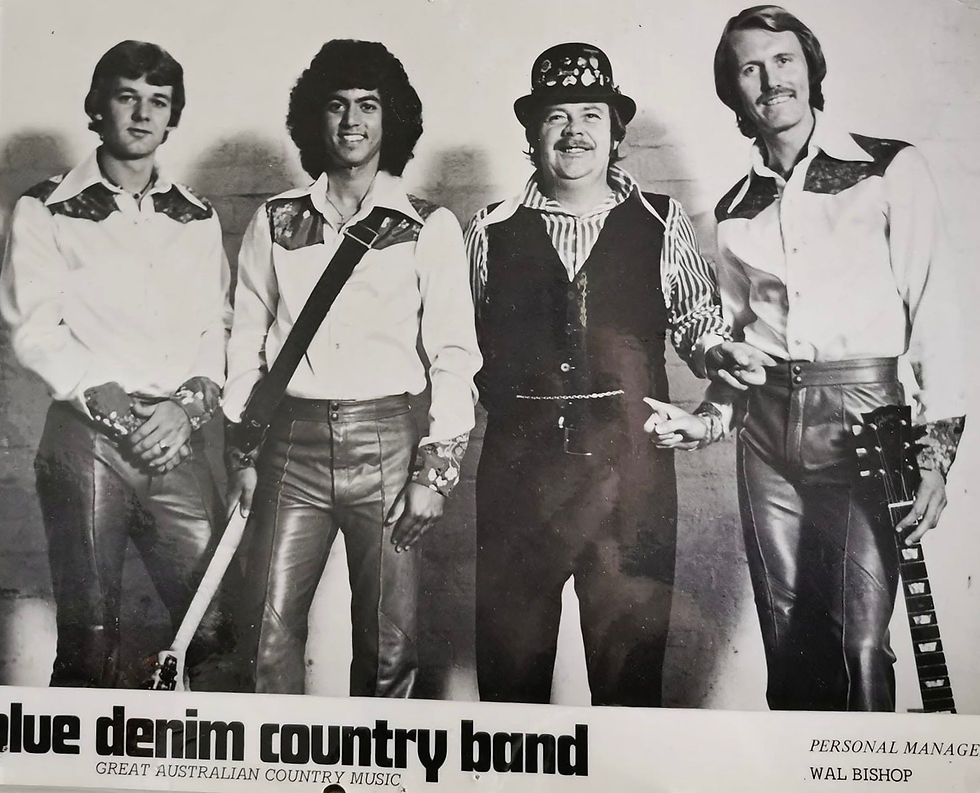
In 1978 Barry joined the Blue Denim Country Band who were backing and touring with Johnny Chester. The first time Barry played with this band it was quite a different show to any he had ever done before. The group played for the inmates in Pentridge Prison. A newspaper article at the time reported,
“Johnny Chester and the Blue Denim Band shook the foundations of B Division at Pentridge with two hours of foot tapping country music. About 50 prisoners clapped, whistled and cheered as the band sang their way through favourites like 'Midnight Bus', 'Rose Of Cimarron' and 'Shame & Scandal'.”
The members of the Blue Denim Country Band when Barry joined were Ray Hasler (pedal steel guitar), Clayton Saunders (bass), Frank Hickey (drums) and Barry Roy (lead guitar).
Doug Watkins was a roadie who worked for the Blue Denim Band and later became the drummer for this band. He has many great memories of being on the road with Barry. He posted this comment on Facebook,
“I was lucky enough to witness amazing live performances with you mate. Not only whilst you were on stage but also on the bus, in the motel rooms, you even took your guitar to the toilet with you (the reverb from there was fantastic). I don’t think you even put your guitar down, we had so many amazing times, a lot of which I couldn’t mention here. One of the memories I still talk about today were the tapes (radio shows) you and Grantley Dee used to make … Mate, you are one of the funniest and most talented people I have ever known.” (Doug Watkins, Facebook May 2026)
The tapes mentioned were impromptu radio type shows Barry and Grantley Dee made for fun. They were distributed privately among close friends and musicians. Called the ‘Great BR Show’ the tapes were really popular. Barry recalls,
“We did them at Grantley’s place and they were outrageous. Grantley had a DJ voice, and I used to put on this voice and say, ‘Hi dee hi, this is the Big BR here singing.’ We just carried on like pork chops, but it was funny. It was made up on the spot. You could feed Grantley a line and he could talk for five minutes about it.”
In late 1978 Barry was asked by W&G to record a country instrumental album and was given the task of organising a photo shoot for the cover. John Chester advised him,
“Don’t muck around with this, go to a mansion in town and hire yourself a blue dinner suit and use your gold Gibson guitar. Make it look like a million bucks.”

Barry followed this advice but when he tried on the dinner suit, the pants did not fit. So, the photo on the front cover of the album shows Barry sitting at a table wearing the blue dinner suit jacket with no pants on, which of course was hidden by the table. The LP titled ‘Play Me A Song’ is a collection of instrumental country favourites. Keith Moore produced the album and Barry was backed by an excellent group of musicians including Barry Joyner (pedal steel guitar), Doug Wallace (fiddle), Harold Frith (drums), Keith Moore (piano, synthesiser) and Peter Hayes (bass, banjo).
Throughout the ‘70s, Barry did a lot of session work on Australian country music releases. He was the resident guitar player at Rudy Brandsmar’s Studios in Box Hill and is credited on numerous recordings as producer, guitarist, dobro player and backing vocalist. His ‘70s albums include ‘Kevin Shegog’ (Kevin Shegog 1974), ‘Greensborough Music’ (Johnny Chester 1975) and Jet Set Country (Ray Kernighan 1978), which earned Barry his first Gold Record Award. Barry recalls,
“I did that many recordings for the country music scene. I’d be driving along listening to a country music station and I’d be thinking, ‘Jeez, I like that’. All of a sudden, they’d say who it was, and ‘Barry Roy playing guitar’. I’d feel embarrassed thinking that sounds good and it’s yourself.” (Refer to discogs.com for a listing of 44 recordings Barry has credits on).
PART 3 – THE PLAYERS TO THE HOWIE BROTHERS 1980 - 1989
Moving into the ‘80s Barry continued his busy schedule of touring, session work and helping other bands. Barry says, “My whole life consisted of being in a band and sorting out other bands and filling in with them.”

In 1981 Barry joined Cash Backman & the Players. Cash Backman (born in Germany, May 4, 1947) managed to combine a career playing music with an acting career. In 1974 he scored a Top 10 hit with a cover of Jim Stafford’s My Girl Bill. His acting credits include mostly tough guy roles in ‘Homicide’, ‘Cop Shop’ and ‘Division 4’. The members of the Players were Denis Tucker (bass), Barry Roy (guitar), Alan Bowles (keyboards, harmonica) and Dave Williams (drums). Barry produced the Cash Backman & the Players single After The Love Is Gone/I’ll Never Say Never Again, Again released on Project 9 Records in 1981.

Another recording Cash Backman & the Players made was a cassette sponsored by Caterpillar Trucks titled ‘The Cat Man’. It was a giveaway cassette featuring country songs with advertising snippets for Caterpillar Trucks scattered throughout.
During the time Barry was with Cash Backman & the Players there were a lot of incidents that occurred while touring. But Cash was always there to help Barry out and save him from some tricky situations.
“I was wearing a Greyhound Country Music Express t-shirt and on the back was a map of Australia. And I’m in a bar in Tasmania without the map of Tasmania on the shirt. All of a sudden, the biggest bloke in the world comes up to me and says, ‘I’m gonna rip that t-shirt off and shove it up your arse!’ Anyway, Cash walks in and said, ‘Any trouble here Baz?’ And I looked at the big guy and the big guy looked at Cash and he said, ‘No, we’re just having a talk.’ “

During the mid ‘80s Barry toured with the internationally famous singer Diana Trask. Diana Trask (born in Camberwell, Melbourne June 23, 1940) is considered to be one of the first Australians to find success in the US in the pop and country music genres. Trask and her American businessman husband, Thom Ewen, were keen tennis players, as Barry and the rest of the band were about to find out. Barry recalls,
“She told us to bring our tennis rackets. We’re going to be playing tennis and we’re going to have a competition. It was a very interesting tour. It was fun and she could really sing.”
The first show was at Alice Springs. Barry arrived at Tullamarine airport early but missed the flight because the speaker where he was sitting wasn’t working. He went to the departure desk and said, 'You’ve gotta stop that plane, I’m playing guitar in a band for an international artist.' The airline official looked at Barry and said, “We’re not stopping a plane for a guitar player.”
At the end of the tour Trask gave each band member an unusual gift - a key ring with a gold dustbin inscribed ‘Diana Trask’. But the ‘k’ was crossed out and ‘h’ added to read ‘Diana Trash’.

Another memorable tour Barry was part of in the ‘80s, was a three-week tour of Tasmania with Australian country music singer Chad Morgan. Chad Morgan (born in Wondai, Qld, Feb 11, 1933 - died Jan 1, 2025) was known for his “Vauderville style of comic Country & Western and folk songs, his prominent teeth and goofy stage persona.” (Wikipedia). The tour started in Launceston and travelled to Zeehan in northern Tasmania. Barry recalls,
“It was fascinating, there were thousands of people at every airport. It was like touring with Elvis. I couldn’t believe it, there was always a long line of girls wanting to hug and kiss him. He sometimes forget the words to his songs during his shows and the crowd loved him so much they’d yell out, ’Don’t worry Chad, we know the words.’ And they’d all start singing.”

In 1985 Barry joined the Allstars. But he would leave and rejoin the band to fit in other commitments. The Allstars had a long history in Melbourne. The Henri Bource Allstars were formed in 1957 and recorded what was arguably Australia’s first rock ‘n’ roll album. The group disbanded in 1959 when Bource joined the Thunderbirds.
Saxophonist Henri Bource (born in The Netherlands March 25, 1934 – died Sept 4, 1998) left the Thunderbirds in 1962 then played with the Planets, the Johnny Donohue Quartet and was part of the backing group for the ABC TV show ‘Teen Scene’ starring Johnny Chester in 1964.
Another of Henri’s interests was underwater photography and in November 1964 he was attacked by a shark and lost his left leg. Losing a leg did not slow Henri down one bit and in January 1965 he was back at the ABC studios for the start of the 1965 ‘Teen Scene’ season. Henri was part of line-up when the Allstars reformed in 1983. Barry recalls,
“He had a fantastic rock’n’roll tone, not a lot of people can get it. That raspy sound. Graham Bloomfield who came after Henri, he could get it as well.”

Thanks to the organising skills of bass player Ian B Allen, Barry got to work with an impressive list of local and overseas artists over the next four decades as a member of the Allstars. Some of the great acts Barry backed and got to meet in the ‘80s include the Platters, Gene Pitney, Chubby Checker, Buddy Knox, Buddy Holly‘s Crickets, Barry Stanton and Lonny Lee. The Allstars 1987 line-up included Ian B Alan (bass), Graham Broomfield (sax), Barry Roy (guitar), Murray Robertson (keys) and Ron Chapman (drums).
The Allstars backed the much-loved Melbourne singer Marcie Jones, and they performed a show with Tom Jones. Barry recalls the Welsh singer coming over to say how impressed he was with Marcie’s singing.
The Allstars recorded a cassette featuring Marcie Jones titled ‘Good Rockin’ Tonight.’ Op shop hunters should keep an eye out for this cassette, it is currently listed on Discogs for $95. Tom Jones was also on the bill of another show the Allstars performed at, at the International Indoor Sports Centre in Canberra in 1990. Barry remembers the group talking to Jones at sound check,

“Tom Jones came over to us and said, ‘I’m really excited to be here in Australia mainly because I brought over the Sweet Inspirations to back me.’ Listening to Elvis‘ former backing group in rehearsal made the hair on the back our necks stand up.”
In February 1984 the Allstars were part of the show when the Shadows performed at the Melbourne Concert Hall. Barry recalls,
"I was in the back room and Hank Marvin came over to me and introduced himself. He said, ‘Hi, I’m Hank Marvin.’ and I was supposed to say, ‘I’m Barry.” But what came out was, ‘Um arrrh urr um’, I couldn’t speak. I was in total awe because Hank Marvin & the Shadows is why we all started playing.”
When Barry played with the Allstars the night they supported the Shadows he was playing a very special guitar, Charlie Gauld’s 1959 Gretsch. Charlie Gauld (Born 1943 – died June 1, 2016) was a major influence on many budding guitarists as lead guitarist with the Thunderbirds. Later he became the resident guitarist at W&G Studios and then became the lead guitarist and arranger for Brian May’s ABC Showband. Barry recalls how he came to own the guitar,
“I was in Ron Lee‘s music store in Highett and I just said, ‘What’s that Gretsch?’ ‘It’s Charlie Gauld’s’. I said, ‘I’ll have it.’ So, I brought it and about three months later Charlie contacted me and said, ‘I want it back, it was part of my early successes, and I miss it.’ Being a fan of the man, I gave it back. I just couldn’t keep it once I knew one of my heroes wanted his instrument back. I ended up being such a good friend of his going to his house and playing together. He was so far advanced with his music, he was one in a million.”

Another band Barry was part of at this time was called Legend. The band played a mix of country and ‘50s rock ‘n’ roll. The members included Judy Neuman (lead singer), Dale Cameron (bass), Don Ferguson (rhythm guitar) and Ron Chapman (drums). Barry also played with Homestead a country dance band which included Jazzer Smith, Geoff Whyte and Peter Hayes. The band lasted for about five years.

During the mid ‘80s Barry played in a jazz band. He admits he could not play jazz guitar, but he did not tell the band that, and says he knew just enough to get through. One of the jobs he did with this band he will never forget. The band had a Sunday gig at a jazz venue called the Atrium at Safety Beach, a seaside suburb on the Mornington Peninsula.
The big attraction that day was Sally the Singing Dog along with an Elvis tribute artist. The Elvis impersonator did not turn up, but his costume was in the back room. The rest of the band all turned to Barry and said, “Do you know any Elvis songs?” to which Barry replied, “Yes, but not as a tribute artist.” Barry recalls, “When I went into the room, Sally turned into a nasty wolf, and she bit me on my pinorkle. I said, ‘I’m not going back in there.’ “

Some of the band members went into the room and put Sally in another room so that Barry could get changed.
“I did the show, and it went alright. I never asked why the Elvis impersonator didn’t turn up, but here I am in an Elvis outfit that didn’t fit me. I knew all the Elvis keys and we had to change them to D flats in the end. We all had a great time because they were drinkers, so that helped a lot.”
In 1982 Barry produced comedian Col Elliott‘s album, ‘Hey You Bloody Mug’, which received gold record status. Elliott was so pleased with Barry‘s production on that LP, he asked him to produce his next album, ‘Move Over Rover’ in 1984. Similar to what has happened to Barry before, they were one song short. Barry played Elliott a song he had written called Rose and he loved it.
“Col was so wrapped in it he brought in a whole orchestra. He brought in a cello, an upright bass and a couple more classical instruments. It was really emotional. I said, ‘It’s not that good.’ He said, ‘Well I like it.’ “
The emotional love song Rose is quite different to the other songs recorded by the veteran comedian. These include Busting Bladder Blues and Since You Rearranged My Face

Barry has had a long association with the Howie Brothers. Twin brothers John and Graeme Howie are a country music duo known for their distinctive harmonies. Barry played on the recordings when the brothers were part of the country group 1910 in the late ‘70s/early ‘80s. He also helped out in subsequent years playing guitar or dobro and adding vocal harmonies to their many singalong recordings (around 40) including, ‘Singing Till The Cows Come Home’ and ‘100 Songs To Sing In The Shower’. Barry also played in their backing band at festivals and joined them on many of their popular country music tours.
“They used to take around 2000 cassettes to Tamworth and sell them all. They were a popular group, and they were audience aware.”
Familiar Faces was another group Barry played in, in the mid-'80s. Although he wasn’t with them for long the band is memorable because vocalist Diane Faulkner had such an amazing voice. The other group members included Diane’s husband Brian Czempinski on drums and bass player Kenny Leroy. Barry recalls,

”Diane would do 'Jolene' and would go to high C and just when you’d think she couldn’t go higher, she’d go three or four times higher. It would stop the show. The crowd would say, she was using a machine to do that. She was a stunning singer.”
In 1989 Barry was kept busy working with the Allstars. In April they backed popular local singers Bobby Bright and Grantley Dee for a show at the International Hotel in Frankston and toured with US legend Del Shannon in March.
PART 4 – ROYZ BOYZ TO ROCKIN’ DADDIES 1990 - 2025
Throughout the ‘90s and into the ‘00s Barry’s hectic work schedule did not slow down. He played in several bands, was part of many tours and fitted recording sessions in when he could.

In the early ‘90s the line dancing craze was sweeping the country. Barry formed a three-piece group called Royz Boyz playing the style of music that appealed to the line dancers. The members included Barry on guitar, Terry Causon on bass and Ron Chapman on drums. The group played at the Italian Club and packed out the hall every time they performed there. It was a group Barry enjoyed being part of. He recalls,
“We were a hit with the line dancers which was a good thing in those days. They knew thousands of different steps. You could play any song, and they would have a dance to it, I couldn’t believe it. Unfortunately, it was short-lived because all of the guys in the group were so busy doing other things.”
Around the same time Barry filled in quite a lot with Flashback a band that played covers of the ‘50s and ‘60s. The group started in the late ‘80s but continued well into the ‘90s. Members included Danny Boyd (vocals), Donald Hill (drums) and Ian Mair (lead guitar). Gwyn Smith later replaced Ian Mair. Barry recalls,”Lead singer Danny Boyd was a great vocalist who could do all the big ballads of Elvis and Roy Orbison.”

In the mid ‘90s Barry was part of a three-piece band called Double Or Nothing. They used backing tracks and Barry and Graham Dean took turns playing lead and rhythm guitars. Kathy Raydings was the vocalist. Barry produced and played on Kathy‘s 1995 debut album ‘Online’. Also in 1995 the group were invited to play at the celebrations marking the 25th anniversary of the Phosphate Corporation in Nauru. Barry took his treasured 1954 Telecaster on this trip which he says, “I haven’t got it now, I could’ve bought four houses if I still had it.” The trip went well, and they were treated like kings by the people of Nauru.
Barry continued his involvement with the Allstars and in January 1992 the group issued a CD titled ‘Still Rockin’

On.’ The album included some of the artists the group had recently backed at their shows including Grantlee Dee, Merv Benton and Marcie Jones.
Throughout the ‘90s and into the early ‘00s the Allstars’ Ian B Alan continued to import big names of ‘60s rock ‘n’ roll. The group played regularly at a dance at the Moorabbin Town Hall and backed a number of local and overseas artists. In 1995 the Allstars did a national tour with Gerry Marsden.

In 2006 a CD titled, ‘Be Our Guest’ included tracks by Chan Romero, Johnny Preston, Lucky Star, Rick Diamond, Betty McQuade and Joan Mifsud, all backed by the Allstars.
In 2007 the Allstars did a three-week tour with shows in Melbourne, Canberra and Sydney with country music legend Johnny Tillotson.
From the mid-‘90s Barry was part of the outback sightseeing tours organised by John Howie of the Howie Bros. The tours were small group tours with a focus on country music and would include visiting natural landmarks, historic towns and museums. Barry was also invited to be part of the international music cruises John Howie began hosting in 1995. The cruise trips combined ocean travel with exclusive concerts, sightseeing and on-board entertainment. Barry travelled on five of these cruises travelling to Europe, China, Japan and New Zealand. Other artists he travelled with on the cruises included to Gill Delaney, Adam Harvey, Becky Cole, Guy Clark and Chris Anthony.

In 2013 Barry was part of a band called Beat Street a group who performed a show that featured the music of Bobby and Laurie, then in 2015 he joined the Rockin’ Daddies a band that played ‘50s rock ‘n’ roll. Members included Cliff Jolly (vocals), Artie Shrugg (drums), Neil Hobbs (slap bass). Hobbs was replaced by Ray Houston on bass in 2018.
The Allstars played to a sold-out show featuring legendary US acts the Crystals and Chris Montez at Palms Crown Casino Melbourne in 2018. Three years later at the same venue on March 21, 2021 the Allstars played their final show. Later that year Barrie was thrilled to receive the ‘Sidemen Award’ from the Australian Rock ‘n’ Roll Hall of Fame.
Due to health reasons Barry stopped performing in bands in 2025. He performed with the Howie Brothers for one last time at the Downtown Club in Warrigal on March 7, 2026,
Barrie has around a thousand stories about the time he spent in the music industry, and he has his own unique way of telling them. He still keeps active musically by getting together once a week with upright bass player Leon Heale. They perform at his home in Seaford which is posted on Facebook. Reflecting on his epic career in music, Barry says,
“I jammed that many things in and I played with so many bands, it’s hard to remember everything. All of us guys were oh so glad that we did it, because you can’t do it now. We worked our butts off, and I didn’t realise what we were doing. Just loved to play, it was great.“

Longtime bass player and musical director for Max Merritt, Glenn Suckling recently commented,
“I’ve got absolute admiration and respect for Barry. The guy’s just a walking music machine. He has a lot of music industry knowledge and it’s hard to find people with that level of knowledge these days. His enthusiasm and willingness to work all the time just blows me away, he’s inspirational. A lovely man, I really dig Barry.”
Written and researched by Graeme Brown Please seek permission to copy any part of this story, including text & photos
|
Discography
With the Blackhawks
8 track 10” acetate 1960
With Strings Unlimited & Johnny Farnham
I Feel Fine, I’m Down, Don’t Let The Sun Catch You Crying Rambler 1966
With the Henchmen
Baby I Need You/Come On Down To My Boat Baby Columbia DO 8587 12/68
With Ray Moore & the Nashville Sound
Reach Out/Ode To A Truckie Cumquat CQR 7-12 1973
With Jigsaw
Sunday Girl/You Fable FB 205 01/74
A Rose Has To Die/Music Man Fable FB 218 06/74
Light Up The World/Take Me Daddy Fable FB 232 12/74
Teach Me How To Rock/ N Roll/You Fable FB 300 11/75
Every Day, Every Night/Music Man Fable FB 300 01/77
Best Of Jigsaw LP Fable FBSA 043 1974
How Do You Do?, Sunday Girl, So I Tell You, Belinda Love, Sind Along, Clap Your Hands/Yellow River, Every Day Every Night, To Love Means To Be Free, Mademoiselle, Sweet Little Rock And Roller, Music Man.
With Johnny Chester & Jigsaw
She’s My Kind Of Woman/(Baby Won’t You) Send Your Sweet Lovin’ To Me
Fable FB-211 03/74
My Special Angel/Nowhere In Particular Fable FB-226 08/74
Sally On Sunday/Once I Was A Truck Drivin’ Man
Fable FB-239 02/75
Solo
Play Me A Song LP W&G 1978
With the Allstars
Good Rockin’ Tonight feat.. Marcie Jones Cassette ARS 4000 1987
Still Rockin’ On CD 1992
Be Our Guest CD 2006
Betty McQuade Collection CD (6 live tracks) Entertainment Assist ASR 1009.2 2012
With Cash Bachman & the Players
After The Lovin’s Gone/Never Say Never Again,Again Project 9 Records D.D.10082 1981
The Catman Cassette 1982
Session work (Not complete):
Tempo Of The Times - Play For Your Pleasure LP W&G WG-35/S/5668. 1973
Leon Lowes with Maggie Stewart – People – Ripling Waters LP W&G WG35/S/5680 1974
Kevin Shegog – Self-Titled LP W&G 1974
Johnny Chester – Greensborough Music Fable 1975
-Self-Titled Image ILP794. 1978
- Among My Souvenirs Rich River Records HSLP.001
Terry Gordon – That’s My Style LP W&G WG.35/S5657. 1975
Ray Kernaghan – Me & Louie On The Road LP Bullet 1977
-Jet Set Country LP Bullet BLT-12-004. 1978
Dave Pincombe – Sweet Music Man LP Astor. 1979
Lee Conway - Rebel Records AL REB 001. 1981
Col Millington – In Albury Wadonga LP Rich River Records CMR 1982. 1982
John & Mary Kopke – The Ship Mahogany LP Platypus Platters PPSLP 1002. 1982
Frank H Parker – As Years Go By LP EMI Custom YPRX1960 1982
Johnny Heap – Sunday Afternoon & Country Music LP Bunyip BLS 322. 1983
Ian Castles – Mansion On The Hill LP Bullet BLT-12-430. 1983
B J McKay – Memories … The Way It Was LP Tempo. TP 113. 1983
Melinda Johnstone – The Girl From Snowy River LP Bunyip. 1984
Col Elloitt – Move Over Rover LP Col Elloitt Enterprises COL 30006. 1984
- Hey You Bloody Mug
Denis Tucker – Self-Titled LP Rich River Records DTR 1986. 1986
Wayne Appleby – Shadows On The Sand LP Rich River Records. WAR 1990 1990
Kathy Raydings -When I Dream Cassette. 1990
- On Line CD Black Market Music BMM 203.2. 1995
Merv Gleeson – The Songs Of Merv Gleeson LP Bullet BLT-12-440
The Howie Brothers – Songs We Sang At Home CD Glenample Records GL 010
Singalong Christmas cassette Glenample Records GL-013
20 Love Songs cassette Glenample Records GL-014
Favourite Songs cassette Glenample Records GL-015
Requests CD Glenample Records GL-020
Bush Ballads 2 Glenample Records GL-022
Cathy Brennan – In Love With Country LP MA-12224
Noel Dobell - Love Song Of The Waterfall LP Midland Records MP 613
Yodelling Ranger Records RRCS-3148
Johnny Heap – Lavender Blue & Other Love Songs CD Smokey 001
Sources:
Graeme Brown – Sunshine Secrets, Moonlight 2019
Paul McHenry, Zbig Nowara, Chris Spencer – Aust. Bands Of The Sixties, Moonlight 2001
Zbig Nowara - Strings Unlimited article, Australian Music Museum, August 1999
Barry Roy -Interviews May 27th, 2026; June 2nd, 2026; June 9th, 2026
Glenn Suckling – comments via phone August 15th, 2026
Denis Tucker – comments via phone August 23rd, 2026


Comments